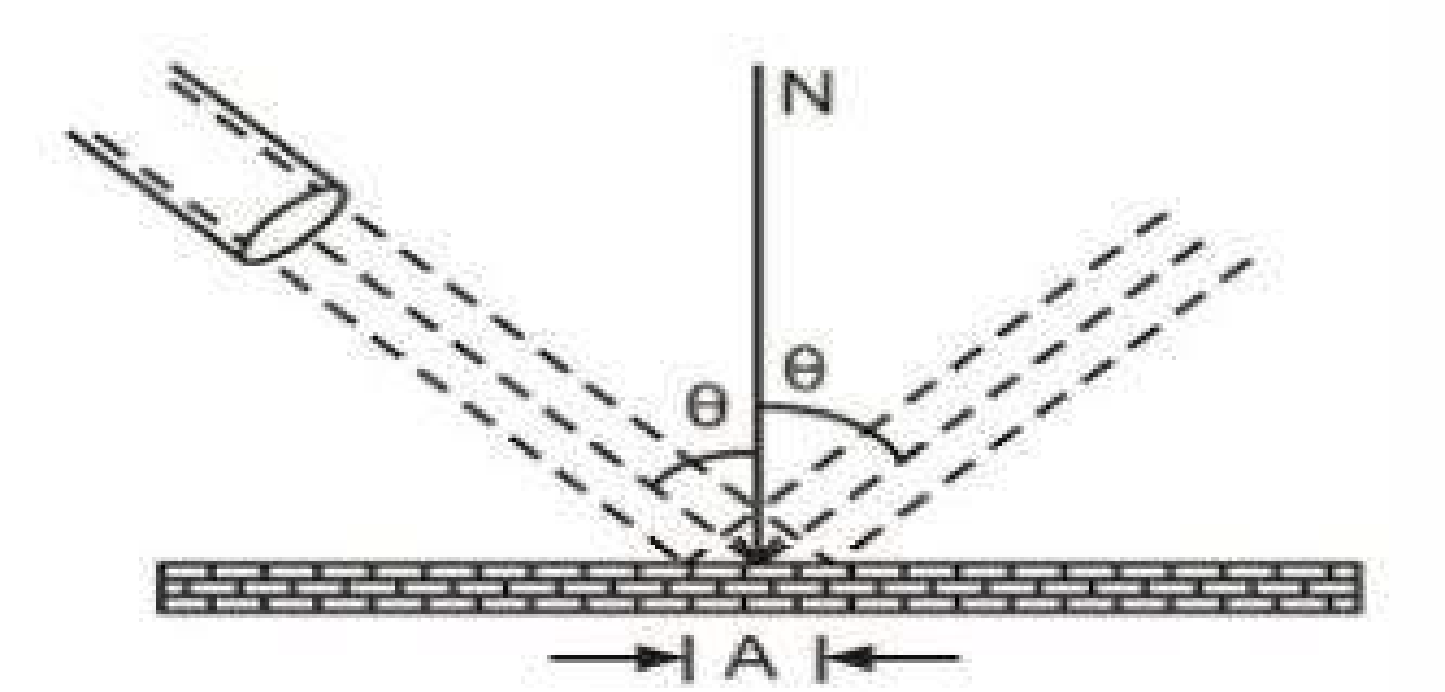
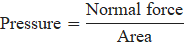
A nozzle throws a stream of gas against a wall with a velocity v much larger than the thermal agitation of the molecules. After collision of the molecules with wall the magnitude of their velocity remains same. Also assume that the force exerted on the wall by the molecules is perpendicular to wall. (This is not strictly true for a rough wall.) Find the pressure exerted on the wall, (n = number of molecules per unit volume, m =mass of a gas molecule)




Text Solution
Verified by ExpertsA
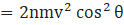
2nmv 2 cos 2 
Since, the molecules rebound from the wall, the component of velocity perpendicular
to wall is reversed, while its velocity parallel to wall does not change. The change in
velocity of molecules is parallel to normal N. The magnitude of charge is
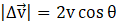
The change in momentum of a molecule is
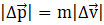

in the direction of normal N. Let n be the number of molecules per unit volume. The
number of molecules arriving at an area A of the wall per unit time is the number in a
slanted cylinder whose length is equal to the velocity v and whose cross-section is A
cos 
Number of molecules = n (Av cos  ).
).
Each molecule suffers a change of momentum 2mv cos  . Change of momentum of the
stream of gas in a direction perpendicular to wall is equal to
(n Av cos  ) x (2mv cos
  ) = 2 An mv 2 cos 2
  .
.
Hence, force exerted by stream of gas on the wall.
F = 2Anmv 2 cos 
This is also the force exerted by gas molecules on the wall.

Prepare Smarter with CGP Edu
Get practice questions, solutions, and test series in one place.
Write a Review
Share your experience with this question and solution.
Commentary
Send your comment, doubt, correction, or feedback to admin.
Similar Questions
Explore conceptually related problems